Can a Model Trained on Millions of Images Learn From Just Hundreds?

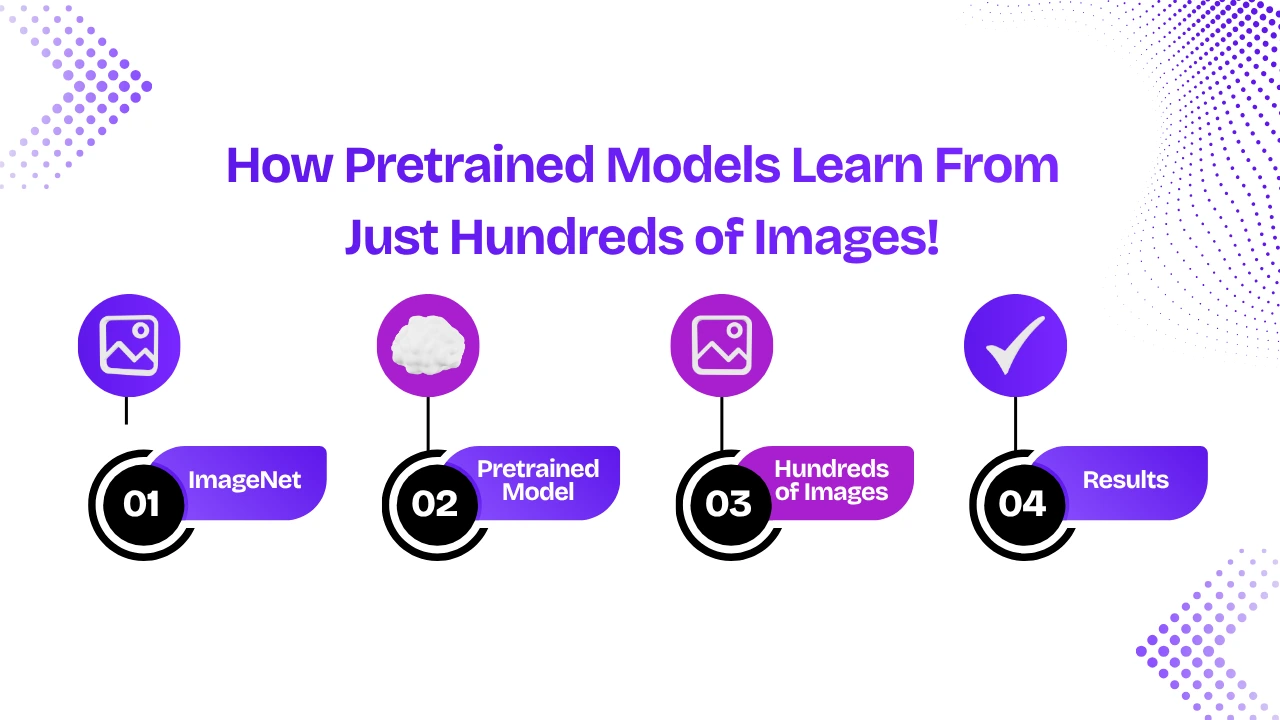
Training deep learning models often requires thousands or even millions of pictures. But what happens when you have only a few hundred labeled photos? Does that mean building an accurate image classification model is impossible?
Not necessarily. Transfer learning offers a practical solution by allowing models to reuse knowledge gained from previously learned tasks. Developers can use significantly fewer datasets to modify an current model for a new problem rather than beginning from scratch.
What Are Pretrained Models?
A pretrained model is a deep learning model that has already been trained on a large dataset. During training, it learns to recognize useful patterns such as edges, shapes, textures, and objects.
For instance, a model that was trained on ImageNet has procured the ability to recognize thousands of different item categories. Even if the new dataset only has a few hundred images, these previously learned features can be applied to another task.
Consider it similar to learning to identify several objects before being asked to differentiate between two particular animal species.
Feature Extraction vs. Fine-Tuning
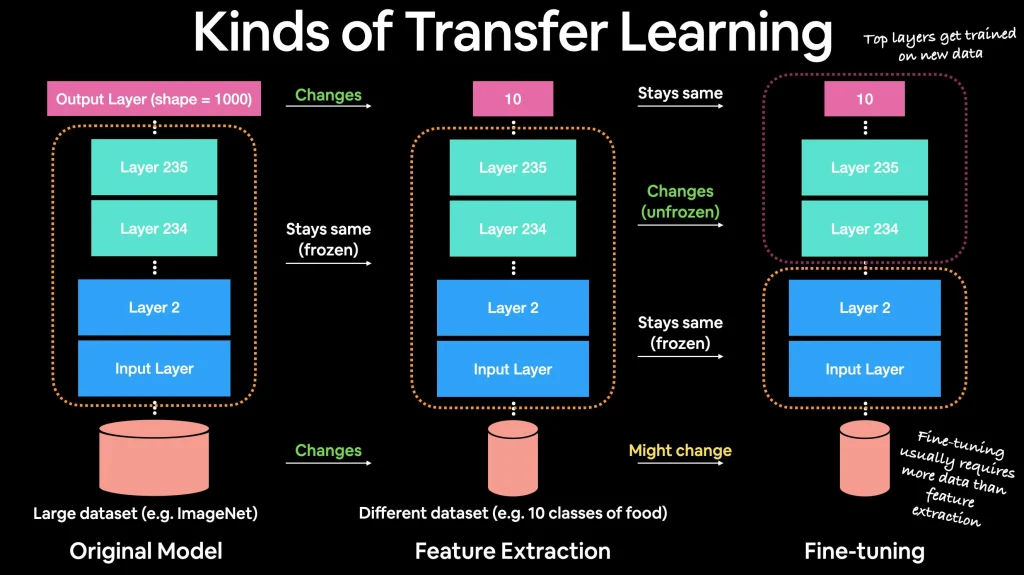
When utilizing pretrained models, there are two typical methods:
Feature Extraction: This method does not change the pretrained layers’ current weights because they are kept frozen. The reduced dataset is used to train a new classification layer. When there is little training data and the new task is identical to the previous one, this is enormously beneficial.
Fine-Tuning: Instead of keeping all pretrained layers frozen, some or all of them are unfrozen and trained further using the new dataset. This allows the model to adjust its previously learned features to better recognize the new categories.
Depending on the dataset, available computational resources, and the resemblance between the original and new tasks, either technique can be effective.
Read More Articles:
- Are Deep Learning Models Affected by Image Compression?
- How I Contributed to LeetCode Next Permutation
Why Are ImageNet-Trained Models Useful?
ImageNet is one of the most widely used datasets in computer vision, containing millions of labeled pictures across thousands of categories.
Pretrained ImageNet weights are frequently available for models like ResNet, VGG, and MobileNet. Because these models already comprehend a wide range of general visual patterns, they offer a helpful place to start.
For example, imagine building a cat-versus-dog classifier with only 300 labeled images. Training a deep learning model from scratch may be challenging because the dataset is relatively small. However, starting with an ImageNet-pretrained model allows you to reuse existing visual knowledge and adapt it to the new classification task.
Transfer Learning’s Advantages and Drawbacks
Transfer learning offers several advantages:
- Less training data: It can reduce the amount of labeled data required.
- Faster training: Training time is frequently shortened by beginning with pretrained weights.
- Lower computational requirements: It can make deep learning more accessible.
- Better starting performance: Reusing learned features can improve results on smaller datasets.
However, transfer learning is not a guaranteed solution. The new task and the initial training data determine how effective it is. Overfitting can still occur with small datasets, and careful training parameter selection is necessary for fine-tuning.
When Might Pretrained Knowledge Not Transfer Well?
The performance of pretrained models varies depending on the kind of image.
Imagine a model that was trained using regular photos. It might be good at identifying everyday objects, but it has trouble with specialized medical images, which can have very different visual patterns and characteristics.
This difference is known as a domain gap. When the original and target datasets are significantly different, previously learned features may not be sufficient.
In such situations, additional task-specific training data, fine-tuning, or even domain-specific pretrained models may be necessary.
Conclusion
Deep learning does not necessarily need millions of images for every new task, as transfer learning showcases. Developers can create effective image classification systems with much smaller datasets by retrofitting knowledge from pretrained models. Pretrained models offer a useful starting point, whether through feature extraction or fine-tuning, but their effectiveness ultimately depends on how well the acquired knowledge applies to the new problem.
